11/1-4はお休みします。No lesson on Nov.1-4th
レッスンがあいていない日時でレッスンをうけたいときは、メッセージを送ってください。都合によって、レッスンを開けることもできます。 Please leave a message from Japatalk, if you would like to take lessons on a fixed date and time,
はじめてのかたは こちらへhttps://www.japatalk.com/lesson_detail_00000869.php
自己紹介(じこしょうかい)
3人の息子の母親(ははおや)です。
神奈川県(かながわけん)、鎌倉(かまくら)の ちかくに すんでいます。
Hello! My name is Mikiko.
I am a native Japanese speaker and mother living in Kamakura Kanagawa, Japan with my husband and three sons.
私は日本語ネイティブで、日本語教師の資格(しかく)をもっています。
あなたの同僚(どうりょう)、先輩(せんぱい)、お母さん、友達(ともだち)、お姉さん(おねえさん)、妹(いもうと)と思(おも)って、気軽(きがる)に話してください。
I'm qualified as a Japanese teacher. I hope you feel free to talk to me as your co-worker, senpai, mother, sister, and friend!
わたしのかんがえ(My policy)
できるだけ、いきた よくつかう にほんごを はなせるように サポートします。あなたの 日本の世界(せかい)が ひろがることを もくひょうにしています。
はじめての レッスンの ときには、かんたんな じこしょうかい を してください。あなたが よくつかう日本語、はなしたい、ひつような 日本語からはじめましょう。また、あなたが うけたい レッスンについて、いっしょにかんがえ、カスタマイズします。
I will support you so that you can speak the lively common Japanese as much as possible such as words used by young people, trendy words, and polite expressions. I can give you a customized lesson.
I would be happy if I could share speaking Japanese time with you.
Let's enjoy speaking! Don't be afraid of speaking Japanese.
I'm waiting for the lesson reservation.
【レッスンについての注意/attention】
★ビデオ通話でのレッスンを基本とします。(Zoom/Microsoft teams)
★カメラを使用しない場合は、こちらのカメラもオフにします。
★通信状態をよくするために、カメラをオフにすることが時々あります。
★お子さんのレッスンは、通信のトラブルなどで、保護者の助けが必要となる場合があります。Your child's lessons may require parental help due to online communication problems.
★一日に連続で一人4コマ以上のレッスンは できません。ごめんなさい。I'm sorry but I can't do 4 lessons in a row.
【私(わたし)が できること】what I can do for you
Free talk フリートーク(通常レッスン)(650P)
あなたのこと、あなたの国のこと 日本での生活、ニュース、こそだて、かぞく、たべものなど、すきなトピックではなしましょう。はなしたい トピックがあったら、スカイプのチャットボックスにメッセージをおくってください。 About yourself, your country, daily life in Japan, news, childcare, family, pet, cooking, traveling, etc. I look forward to chatting with you as your Japanese friends, colleagues, senpai, moms, sisters, and neighbors. Please leave a message on the chatbox.
・日本語で書かれたニュースの記事を一緒に読み、文法、語彙、慣用表現、日常的な言い回し、発音などを学びます。日本の文化・習慣の理解、話題になっていることなど、読後に意見交換もします。(対象:N3以上)希望に応じて、レッスンメモを作ることもできます。
・みんなの日本語初級、初級日本語げんきを終わった人におすすめ。
読む・話す・聞く・書くの4技能がバランスよく勉強できるレッスンです。
「中級日本語カルテッド」Japan Times publishing の教科書を使います。
・テキスト「しごとの日本語(IT業務編)アルク出版」を使って、レッスンします。面接から場面会話、仕様書を読む内容など、IT業界の方で日本語を勉強する方向けのレッスンです。(中級以上)
・学習者のニーズ、職務内容、リクエストに合わせレッスンを心がけます。
・技能実習生から仕事で日本人顧客を想定したビジネスマンまで、ビジネスマナー、メール対応、敬語、実務を想定したレッスン内容をめざします。レベルに合わせ、目標に向かったレッスン
あなたがうける JLPT のレベルから 語彙(ごい)をえらんで、フリートークしましょう。会話(かいわ)の中で 語彙(ごい)や文法(ぶんぽう)を使うことにより、おぼえることができます。ニュースの記事(きじ)やコラムなどをつかって、語彙(ごい)をふやしたり、例文(れいぶん)を作ったり、文法(ぶんぽう)や慣用句(かんようく)などを学ぶことができます。感想(かんそう)や意見(いけん)を 話すことによって、スピーキングも身につきます。チャットボックスや ファイルの共有(きょうゆう)でフィードバックもできます。e-mailがひつようです。
Would you like to increase your JLPT vocabulary? If you increase your vocabulary in conversation, you will easily remember them.
You can also talk with a vocabulary that suits your level as a preparation for JLPT. I can offer feedback with chatbox or file sharing. E-mail address required
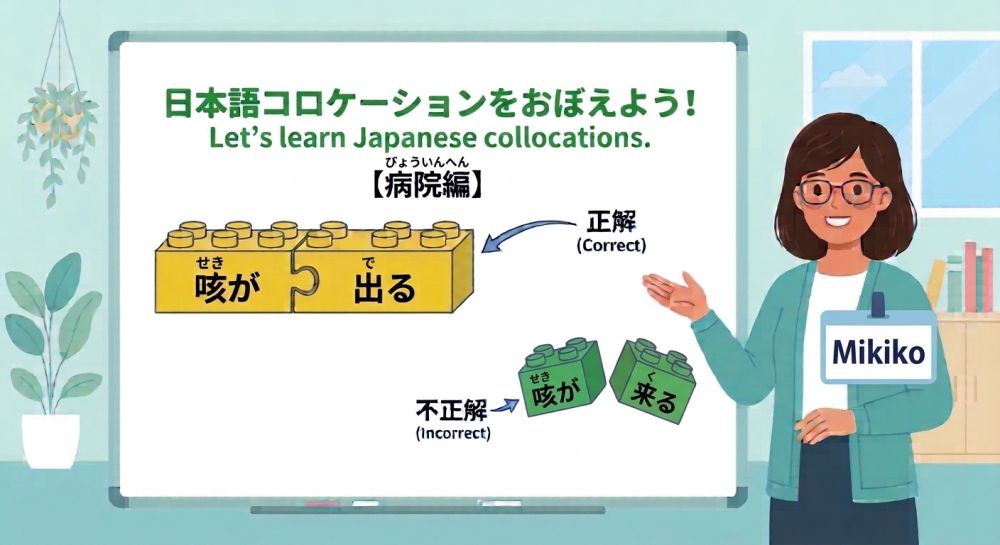
日常会話、アニメなどでよくみる オノマトペ。知るとおもしろい、知らないと わからない!【オノマトペ】をトピックに、解説、使い方を学ぶレッスンです。(中級者以上)
こんな時、どんなふうにいいますか?
毎回 日常会話・ビジネスで よく使うフレーズを 1つか2つ 練習しましょう!
どんなシーンで使うか、どんなと時に使うか 説明します。説明したあと、実際に使って練習しましょう。テキストは使いません。中級レベル以上のかたにおすすめです。
「みんなの日本語Ⅰ・Ⅱ」をおわった中級レベルの方向けのレッスンです。JLPT N2、N3相当の文型と表現を学びます。テキストがなくても大丈夫です。
This is a lesson for intermediate-level students who have finished "Minna no Nihongo I / II". Learn sentence patterns and expressions equivalent to JLPT N2 and N3.
「みんなの日本語Ⅰ・Ⅱ」をおわった中級レベルの方向けのレッスンです。JLPT N2、N3相当の文型と表現を学びます。テキストがなくても大丈夫です。
This is a lesson for intermediate-level students who have finished "Minna no Nihongo I / II". Learn sentence patterns and expressions equivalent to JLPT N2 and N3.
しょきゅう の かたに おすすめ! よむ きく かく はなす の 4ぎのう を たのしく まなべる テキスト[Genki]を つかいます。テキストは英語でかかれていますが、テキストは なくても OK。たんご、ぶん、ぶんぽう、かいわ、にほんのぶんか など せいかつに すぐ つかえる ないようです。かずのかぞえかた、カレンダーのよみかた、じかんのよみかた、かんじ、にほんぶんか など、たのしく にほんごが まなべます。
Recommended for beginners in Japanese. Genki is partly written in English and has comments on Japanese culture and customs. This text is recommended for those who want to learn Japanese starting from daily conversation. Genki is written in English but a textbook must not be needed. I can share them on screen.
日本 の かていりょうり の レシピ を 教材として 日本語を学びましょう!一人ぐらしの人にもおすすめ! 日本には、特有(とくゆう)の材料(ざいりょう)、調味料(ちょうみりょう)、調理方法(ちょうりほうほう)、道具(どうぐ) などが あります。あなたが もっている レシピをつかって 理解しても いいですし、私が 用意(ようい)もできます。すきな 日本の お料理が ひとりで できるようになると いいですね。
We have unique materials, cooking methods, and cooking utensils. Even if you look at the recipe, I will advise you that you can not make it well, you will fail, you want to substitute the ingredients, etc.
If you have your recipe, let me send it in advance, but if you do not have a recipe, I can prepare it from here.
Let's make sukiyaki, vinegared food, miso soup, etc.
Although I don't cook, I will explain or tell you some advice on how to make it. じっさいに りょうりは しません。
一人で勉強するのは大変ですか? JLPTの問題集を私と いっしょに勉強しましょう。あなたの問題集か 私のもっている問題集を使って、一緒(いっしょ)に問題を解(と)きましょう。読解(reading)、文法(grammer)、語彙(vocabulary),漢字(kanji)。問題集がない時は 予約してから、何級の文法をしたらいいか教えてください
希望(きぼう)により 宿題(しゅくだい)も出せます。
Is it difficult to study the JLPT workbook alone?
Let's study JLPT workbook with me. Using your workbook, or mine will be OK. Depending on your level, N4, N3, N2, N1, Reading, grammar, vocabulary, and kanji listening. I have ,総まとめシリーズ、新完全マスター. If you don't have that workbook, please ask me about it.
あなたが はなしたい 文章(ぶんしょう)、おぼえたい歌(うた)など、シャドーイングで おぼえましょう。
なんども くりかえし 講師の発音や高低をまねすること(シャドーイング)で、自然なトーキングを練習できます。
日常会話を ある程度のスピードで話せるようになりたい人におすすめです。Your conversational ability will improve by practicing everyday conversations and frequently used phrases at a natural speed. No text is required.
By instantly repeating the sentences spoken by the instructor, you will be able to speak everyday conversations and fluent Japanese.
おおくの 日本語学校で つかわれている テキストです。ぶんぽうが たいけいだってまなべます。ぶんけい、れいぶん、かいわを れんしゅう します。どうし や めいし の いいかえ をして、ぶんけい の れんしゅう を します。You can paraphrase verbs and nouns and practice sentence patterns.ならった ぶんけいで れいぶん を たくさん つくります。You can make various example sentences by applying the learned sentence patterns.敬語(けいご)、普通(ふつう)ぶん、ていねいけい、動詞(どうし)のます形、形容詞(けいしようし)(イ形容詞、ナ形容詞)など、文法(ぶんぽう)も まなびます。げんざい、日本語学校でまなんでいる方の よしゅう ふくしゅう、しけんなどにもたいおう します。
【わたし が できないこと/What I can not do】
ビジネスマナー エントリーシートてんさく、ほんやく
Business manner/ Correction of entry sheet/translation
★わたしについて about me★
大学を卒業後(そつぎょうご)出版社(しゅっぱんしゃ)で はたらいていました。ソフトウェア雑誌の編集、システムエンジニアもしたことがあります。今は 不動産(ふどうさん)の仕事をしています。I have experience working for a publishing company after graduating from university, as a system engineer, and now at a real estate company.
★わたしがすきなこと…旅行 料理 読書、裁縫、バドミントン、ウォーキング いろいろな国の料理をつくること、たべること、世界の調味料やスパイスで料理をためすこと、日本のホラー
I like travel.cooking,sewing,badminton,walking
★すきなたべもの…てんぷら うなぎ ラーメン おさしみ おこのみやき
I like tempura,unagi,ramen,sashimi,okonomiyaki.
★きらいな もの…セロリ しょうが たかいところ
I don't like ginger, celery, or high place.
★がんばっている こと…
What I'm working on piano,making obento,umeboshi,miso,gathering trend topics for Japatalk.
ピアノ お弁当つくり 梅干し、みそつくり トピックあつめ(ジャパトークのため)英語
★はまっていること
I am into finding out flower name during walking by google lends.
ウォーキング中に グーグルレンズで 草花の名前をしらべること
★もっている教科書
「みんなの日本語ⅠⅡ」「GENKI ⅠⅡ」「どんなときにどう使う日本語表現文法500」「上級へのとびら」「どんどんつながる漢字練習帳初級」「考えて解いて学ぶ日本語教育の文法」「日本語文法ハンドブック」「あいうえおうさま」「Shadowing 日本語を話そう」 「中級へ行こう」「中級を学ぼう」「TRY STARTにほんごはじめよう」(ベトナム語・英語・インドネシア語対応)「日本語総まとめ N2 読解」「新完全マスターN1文法・読解・語彙」「新完全マスター文法、読解N3」「新完全マスターN2文法,読解・語彙」、「新完全マスターN4 文法」「JLPT文字・語彙 ポイント&プラクティスN4/N5」「英語でオノマトペ」「すぐに使える日本語会話超ミニフレーズ200」JLPT単語他多数
★いままで 行ったことがある くに…アメリカ、マレーシア、シンガポール、ドイツ、オランダ、ルクセンブルグ、モルジブ、タイ、オーストラリア,ベルギー、インドネシア,ベトナム
I have been to Germany,Australia, Singapore, Thailand, Moldives Netherlands,Malaysia,Indonesia, Belgium,USA,Vietnam.
★行ってみたい国 …ケニア、エジプト、イタリア,スペイン
The countries I want to visit are Egypt,Kenya,Italia, Spain,Italy...
★今までレッスンをした皆さんの国籍は
中国、USA、UK、台湾、タイ、オランダ、ドイツ、フランス、イタリア、スペイン、ベトナム、アイルランド、スコットランド、韓国、カナダ、シンガポール、フィリピン、マレーシア、インドネシア、タイ、スリランカ、ロシア、オーストラリア、インド、ネパール、スウェーデン、モルディブ、フィンランド、メキシコ、ブラジル、モンゴル、イラン、パキスタン、日本、ポーランド、ベラルーシ、トリニダードトバコ、コートジボアール、スイス、南アフリカ クェート、ナイジェリア、ボリビア、デンマーク、スーダン,オーストリア,ウクライナ,コスタリカetc.…。


 About JapaTalk
 Japanese Teachers
 Pricing
 How to Use
 Special Lessons
 Sensei's Notes
 Zoom Guide
 Reviews
 FAQ
 Contact us